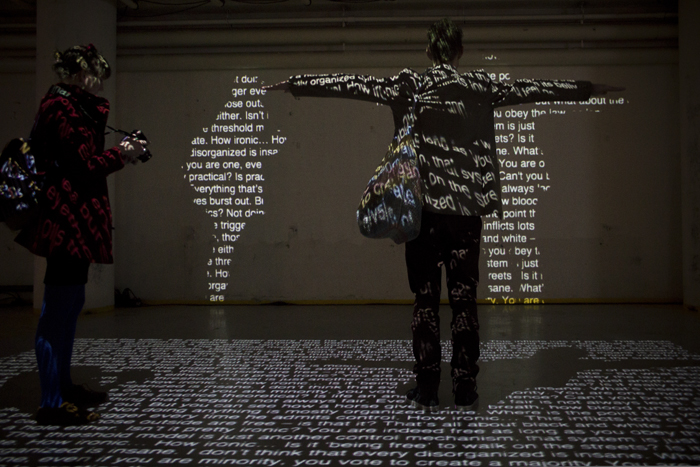
It’s one thing to stand in font of a projector to create shadow puppets, but it’s an entirely different experience to block a text-based floor projection and see your typographic silhouette on an adjacent wall. Istanbul-based multidisciplinary creative studio NOTA BENE Visual has designed a mind-boggling audiovisual installation using an intricately executed video-mapping technique that uses the latest technology to create an artistically intriguing environment for spectators to engage in.
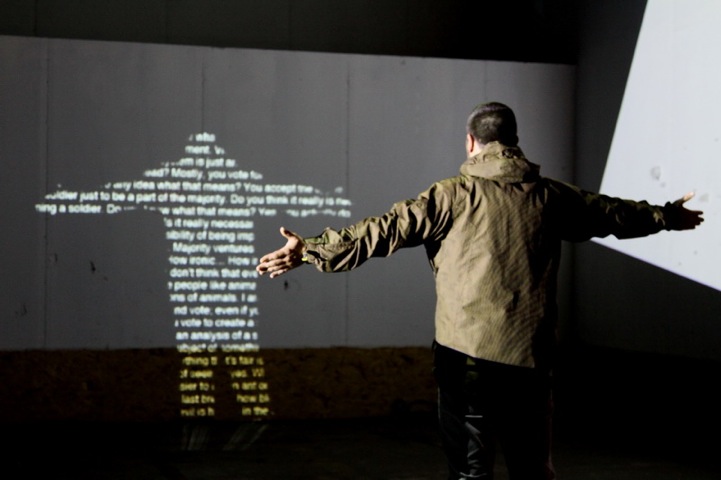
The interactive typographic installation titled In Order to Control features a constant loop of selected text about “the threshold [of] ethics and morality” projected on the ground. (You can read the full transcript of the projection here.) The most interesting thing about the project is the interactivity and its reliance on audience participation. As spectators step into the installation to read the projected content, their blackened silhouette covers the words on the floor and transfers them to the proximate wall.
One could marvel at this technological magic trick for a very long time, especially since there’s still scrolling text to be read. In order to actually read the text, one could technically run back and forth across the screen but it seems far more convenient to form an assembly of people, standing in tandem, eliminating spaces in which words can get lost. This interactive element also alludes to the idea of interconnectivity and how we can all help each other, sharing information.
Be sure to watch the short video, below, to see this installation in action.
Credits: Project Management: Burak Gölge Art Director: Ayşegül Kantarcı Installation Design: Tevfik R. Gözlükçü Concept: Murat Can Oğuz Synopsis: Murat Can Oğuz, Ayşegül Kantarcı Translation: Begüm Avar Edited Video Sound: Amon Tobin
Here are a few more shots of my day with Alisha and Kiana. It was really fun to watch them; I could see they had a nice balance of love, respect and play in their relationship. On our walk we found a mini hutch made of sticks with a sign that read ‘Bat Cave.’ Continue reading →
Check out the clip below, I love the way it was put together!
With 873 photos in motion, AlmapBBDO has created a touching one-minute film for Getty Images. This job required extensive research into the archives of thousands of photos of the brand.
Patient research work involving more than 5 thousand photographs resulted in a one-minute film that AlmapBBDO created to advertise stock library Getty Images. The film is surprising when showing 873 images in 15 images per second, sufficient speed to transform the series into a video that, without any text, tells a story of a life from beginning to end. All photos, without any exceptions, are from the Getty Images archives.
Copywriter Sophie Schoenburg and art director Marcus Kotlhar worked for six months researching images, improving the script and building each scene so they would not only be understood, but would also touch viewers. Sometimes, for example, a scene would look perfect on paper, but the images chosen to depict it were not sufficient or did not perfectly match up to offer the right movement and sense. And hence the research had to be restarted.
The film was directed by Cisma, via Paranoid BR, along with Marcos Kotlhar, the art Director at the agency.
“It was a labour of love”, says Cisma. “Although it uses still images, we tried to make it dimensional with movement and by playing with perspective. All images are 100% from the Getty Images archive. The only thing we did was change the scale and rotation to build the stop-motion sequence. There’s so much in there that it’s a spot that should be watched frame by frame.”
For the creative team, the purpose was to adhere to the concept that Getty Images has so many images that anybody is capable of telling any story they want by only using their archives. In the film “Do amor ao Bingo em 873 imagens” [From love to Bingo in 873 images], a storyteller in the corner of the screen describes the images used.
The Getty Images logo appears at the end of the story, but the storyteller continues to turn until reaching the exact number of images in the Getty Images archive.
Jay Miles, is a very cool and handsome guy who has worked in TV, video, film and commercial production for 20 years, including shows for NBC, ABC, FOX, the Discovery Channel, HGTV, Versus and DirecTV. He has completed productions for businesses (The House of Blues, Cisco/Linksys), bands (Two Man Advantage, The Afro-Semitic Experience) and blogs (On Frozen Blog). Continue reading →
These words write themselves. Carried on the wind, they land within my soul
and place themselves in. Words that move, they have weight.
I can feel the heaviness that they create. Continue reading →
Comments Off on Poetry Corner: Words by Tracey Lee Bates
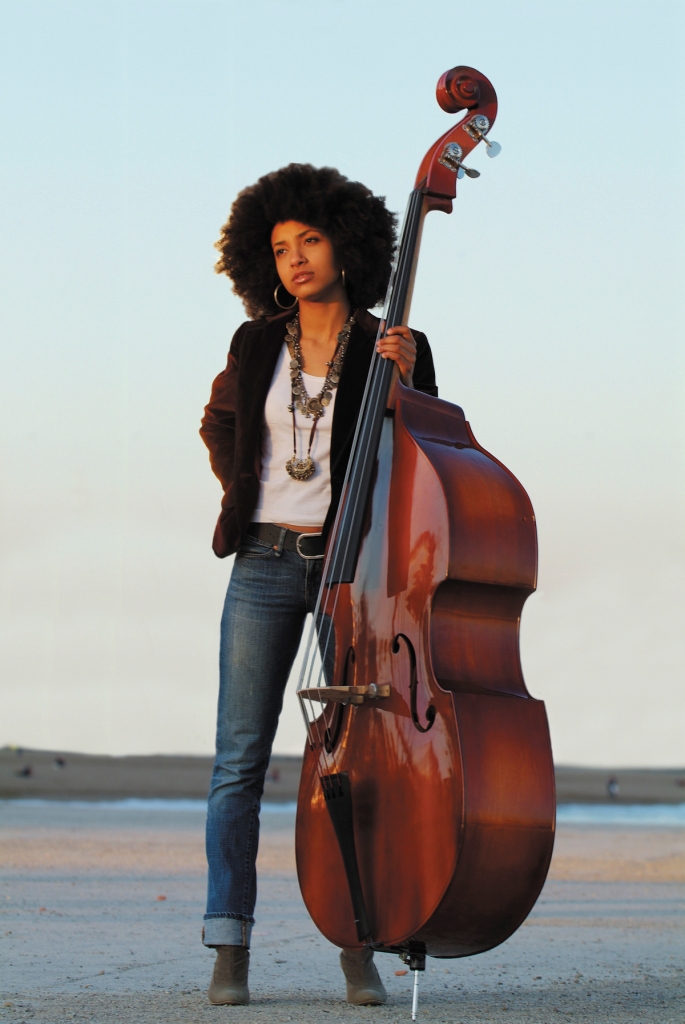
If “esperanza” is the Spanish word for hope, then bassist, vocalist and composer Esperanza Spalding could not have been given a more fitting name at birth. Blessed with uncanny instrumental chops, a multi-lingual voice that is part angel and part siren, and a natural beauty that borders on the hypnotic, the prodigy-turned-pro might well be the hope for the future of jazz and instrumental music.
Spalding was born and raised on what she calls “the other side of the tracks” in a multi-lingual household and neighborhood in Portland, Oregon. Growing up in a single-parent home amid economically adverse circumstances, she learned early lessons in the meaning of perseverance and moral character from the role model whom she holds in the highest regard to this day – her mother.
But even with a rock-solid role model, school did not come easy to Spalding, although not for any lack of intellectual acumen. She was both blessed and cursed with a highly intuitive learning style that often put her at odds with the traditional education system. On top of that, she was shut in by a lengthy illness as a child, and as a result, was home-schooled for a significant portion of her elementary school years. In the end, she never quite adjusted to learning by rote in the conventional school setting.
“It was just hard for me to fit into a setting where I was expected to sit in a room and swallow everything that was being fed to me,” she recalls. “Once I figured out what it was like to be home-schooled and basically self-taught, I couldn’t fit back into the traditional environment.”
However, the one pursuit that made sense to Spalding from a very early age was music. At age four, after watching classical cellist Yo Yo Ma perform on an episode of Mister Rogers’ Neighborhood, the roadmap was suddenly very clear. “That was when I realized that I wanted to do something musical,” she says. “It was definitely the thing that hipped me to the whole idea of music as a creative pursuit.”
Within a year, she had essentially taught herself to play the violin well enough to land a spot in The Chamber Music Society of Oregon, a community orchestra that was open to both children and adult musicians. She stayed with the group for ten years, and by age 15, she had been elevated to a concertmaster position.
But by then, she had also discovered the bass, and all of the non-classical avenues that the instrument could open for her. Suddenly, playing classical music in a community orchestra wasn’t enough for this young teenager anymore. Before long she was playing blues, funk, hip-hop and a variety of other styles on the local club circuit. “The funny thing was, I was the songwriter, but I had never experienced love before. Being the lyricist and the lead singer, I was making up songs about red wagons, toys and other childish interests. No one knew what I was singing about, but they liked the sound of it and they just ate it up.”
At 16, Spalding left high school for good. Armed with her GED and aided by a generous scholarship, she enrolled in the music program at Portland State University. “I was definitely the youngest bass player in the program,” she says. “I was 16, and I had been playing the bass for about a year and a half. Most of the cats in the program had already had at least eight years of training under their belts, and I was trying to play in these orchestras and do these Bach cello suites. It wasn’t really flying, but if nothing else, my teachers were saying, ‘Okay, she does have talent.’”
Berklee College of Music was the place where the pieces all came together and doors started opening. After a move to the opposite coast and three years of accelerated study, she not only earned a B.M., but also signed on as an instructor in 2005 at the age of 20 – an appointment that has made her the youngest faculty member in the history of the college. She was the 2005 recipient of the prestigious Boston Jazz Society scholarship for outstanding musicianship.
In addition to the studying and the teaching, the Berklee years also created a host of networking opportunities with several notable artists, including pianist Michel Camilo, vibraphonist Dave Samuels, bassist Stanley Clarke, guitarist Pat Metheny, singer Patti Austin, and saxophonists Donald Harrison and Joe Lovano. “Working with Joe was terrifying,” she recalls, “but he’s a really generous person. I don’t know if I was ready for the gig or not, but he had a lot of faith in me. It was an amazing learning experience.”
Spalding’s journey as a solo artist began with the May 2008 release of Esperanza, her debut recording for Heads Up International, a division of Concord Music Group, which went on to become the best selling album by a new jazz artist internationally in 2008. The highly acclaimed release was the first opportunity for a worldwide audience to witness her mesmerizing talents as an instrumentalist, vocalist and composer. The New York Times raved, “Esperanza has got a lot: accomplished jazz improvisation, funk, scat singing, Brazilian vernacular rhythm and vocals in English, Portuguese and Spanish. At its center is a female bassist, singer and bandleader, one whose talent is beyond question.”
Soon after release, Esperanza went straight to the top of Billboard’s Contemporary Jazz chart where it remained for over 70 weeks. Spalding was booked on the Late Show with David Letterman, Jimmy Kimmel Live, the CBS Saturday Early Show, the Tavis Smiley Show, Austin City Limits and National Public Radio. Other highlights included two appearances at the White House, a Banana Republic ad campaign, the Jazz Journalists Association’s 2009 Jazz Award for Up and Coming Artist of the Year, the 2009 JazzWeek Award for Record of the Year, and many high profile tour dates, including Central Park SummerStage in New York and the Newport Jazz Festival. 2009 was capped by an invitation from President Obama to perform at both the Nobel Prize Ceremony in Oslo, Norway – where the Nobel Peace Prize is awarded – and also at the Nobel Peace Prize Concert.
And as well as being on the road with her own band, Esperanza has toured with Joe Lovano, and has also performed with pianist McCoy Tyner.
In early 2010, Spalding was the subject of an in-depth profile in The New Yorker, she was also featured in the May 2010 Anniversary issue of O, The Oprah Magazine’s “Women on the Rise” (in a fashion spread that features portraits of 10 women who are making a difference in various careers), and she was again nominated by the Jazz Journalists Association for their 2010 Jazz Award for Up and Coming Artist of the Year.
If Esperanza marked a brilliant beginning for this gifted young artist, then Spalding’s August 2010 release, Chamber Music Society, sets her on an upward trajectory to prominence. Inspired by the classical training of her younger years, Spalding has created a modern chamber music group that combines the spontaneity and intrigue of improvisation with sweet and angular string trio arrangements. The result is a sound that weaves the innovative elements of jazz, folk and world music into the enduring foundations of classical chamber music traditions. Co-produced by Esperanza and Gil Goldstein (with string arrangements provided by both), Chamber Music Society finds Esperanza with a diverse assembly of musicians: pianist Leo Genovese, drummer Terri Lyne Carrington, percussionist Quintino Cinalli, guitarist Ricardo Vogt, and vocalists Gretchen Parlato and the legendary Milton Nascimento. The string trio is comprised of violinist Entcho Todorov, violist Lois Martin and cellist David Eggar.
Esperanza has presented this album with a number of tours across the USA and Europe, as well as travelling to Japan to play at the Blue Note club in Tokyo and also down to the Cape Town Jazz Festival in South Africa. The album has also been supported with TV appearances on the top American late night chat shows, such as David Letterman and Jay Leno.
On Februrary 13th 2011 in Los Angeles, Esperanza received one of the music industry’s most prestigious prizes, the Grammy for Best New Artist. As Esperanza later said, she was surprised and also grateful to receive this award. It had been a very special day, as earlier on Esperanza has cohosted the pre-telecast with Bobby McFerrin and also performed with the Grammy Jazz Ensemble.
As well as a very busy spring and summer touring again in Europe and North America, Esperanza has been working on her upcoming new album, Radio Music Society. This new recording which she herself describes as funkier and more update than its predecessor, is planned to be released in the Spring 2012.
Posted onApril 28, 2012|Comments Off on Artist Profile: Miles Hendrickson
Miles has just finished up his sophomore year at Shenandoah Conservatory studying viola under Dr. Doris Lederer. This is his final chamber music concert of the 2011-2012 school year. Very talented young man. Check him out
Posted onApril 24, 2012|Comments Off on Laughing Raven Studio: Interview with Jeff Hendrickson
Meet Jeff Hendrickson, Proprietor of Laughing Raven Studio. Jeff has a wide-ranging background in the arts; photographer, textile and clothing designer, generative art creator, graphic designer, branding specialist, web designer, speaker, web design instructor and pretty darn nice guy!
Val: “Jeff, you have such a versatile background, was this a planned road map in your career?”
Jeff: “First let me say thanks for this opportunity. I love to be able to share what I do and how I do it with others. Moving along – yes, in my own crazy way this is my road map. My entire professional career has been about visual stimulus. What usually hits us first is what we see. Someone is walking towards us down the street and we notice what they’re wearing, their hair, or the look in their eyes. We pick up a book and we do absolutely judge it by its cover. We walk into a gallery and we immediately start a conversation with the works hanging on the walls. So what I do is make the clothes and the textiles that a person can put on and feel good about. The graphics for a book or CD cover draw a person into that product. And the art hanging on the wall moves someone, somehow. If I’ve created something that moves people positively, then I’m a happy camper.”
Val: “What artistic area did you find most challenging?”
Jeff: “I have to say quite honestly that none of the processes are challenging in a negative way – I don’t view any of this as work. Most of it is effortless for me. My challenges usually come in adhering to restraints that’ve been put on a project, be that very strict direction on what colors can be used for a textile collection, or font limitations for a graphics project. Any time someone tells me I have to color inside the lines I scream. Well, to myself anyway. I really do play nice.”
Val: “Tell me about the work you do now?”
Jeff: “Oh boy Val, how do I explain this? Let’s talk about the art I’m currently creating – that’s the most exciting and relevant to me now. I start off with an interesting photograph that I’ve either taken while driving – with my smartphone – or while walking around on a trip up to Brooklyn, which is where a lot of my work comes from. Anything that catches my eye gets recorded. I’m really into architecture and built forms and structures so a lot of the pieces start with those types of subjects. I then open one up in Photoshop, tear it apart, and put it all back together again, piece by piece, using different filters and effects for each layer. Most recently, I’ve started using work I do in Generative Art – art created using mathematical algorithms and variables – as custom filters. I lay them into separate layers and use different transparency types that react in some really cool ways with the different layers of the photo work. It’s a very dynamic process, sometimes involving parts from a few different photos, and some of the pieces have taken me a week or so to complete. ”
Val: “If a client were considering a total branding package, what do they need to consider before meeting with you?”
Jeff: “First thing to look at is what the currently have and use. Fonts. Colors. Stationery. Current website. Client types. Roles of key business personnel. Types of products. Domestic or international? Anything and everything about what they are sitting with currently. If that’s nothing, and this is the very beginning of them moving out into the world, I get a read on their business philosophy first. I start all clients by having them write a CPR – Context. Purpose. Results.Start with results. What do you want this work to bring to you? More clients? Bigger paychecks? Prestige? A new Mercedes? Whatever it is, write it down – no less than 15, worded as “I want xxx, so that…”. This leads to purpose. The dominant words and phrases from the results get distilled into a purpose, which can be a sentence or two. From there, we get the context – the higher purpose so to speak. The battle cry of the business and what it is that you truly stand for and represent to your clients/customers. Once all this is gathered, I write a loose proposal so that we make sure we’re all on the same page. I talk about current trends I’m seeing, and will discuss whether or not they care about what their competition is doing. You’d be surprised how many people want to copy directly from a competitor. If they insist, I usually turn down the job. It’s unethical and unimaginative. Design is about imagination and the guts to move on it.”
Val: “What projects have you collaborated on recently?”
Jeff: “I’m working with an artist in Trinidad, Tracey Chan. We started following each other on Twitter about two years ago. I’d retweet her stuff, she’d retweet mine. We both admired each other’s work and one day I put it out there that we try something together. We created a Dropbox folder and each put ideas in there. I put some Generative Art things in that she really liked so we went forward with that. I sent her the code, taught her how to use it, and then we each created new work, which we then put together in Photoshop to come up with finished pieces. The bottom-line goal was a show in early spring of this year so we submitted three triptyches to the Brooklyn Artists Gym in Gowanus and got accepted for a show called “Chromophilia” which ran the first two weeks in March. It’s an unbelievable thrill to get accepted to show in NYC. I went up for the opening and quite a few friends came. It was a very magical night to say the least.”
Val: “Are there benefits to collaborating with other artists?”
Jeff: “Yeah, absolutely. Two minds come together with different ideas towards a common goal. Each brings a unique aspect to the team and if you start with an alignment the results can really be great. I think a lot of heart to heart talk needs to happen first though. Just jumping in, while it could produce some great work, is more fraught with disaster than if the artists are honest and upfront about what they want and everyone agrees on a path forward.”
Val: “Do you have favorite work tools, toys and software when doing your creative thing?”
Jeff: “Sure do. Illustrator and Photoshop are my constant companions. I’ve started using Illustrator lately to layout shows. I take pictures of the gallery before hand and then mockup what I want by putting my stuff up on the walls. I use Processing, Context Free, and Structure Synth for the gen art work, and a couple of different fractal generating programs, SpangFractal and Endlos Fractals. The Art Director’s Toolkit is indispensable for quick work with calculations and colors, and Evernote is what I use to keep all notes and ideas for projects. My camera is an Olympus PEN EPL2 and a lot of my current photo work comes from my Android smartphone.”
Val: “What are some personal projects you have going on now?”
Jeff: “I’m getting ready for a show in June, at the First Fridays thing that’s done in Falls Church, VA. I’ll be at Fall Properties, a really cool boutique real estate company that’s office is like a gallery. Each show turns over the first Friday of the month and the wall space is great. I’ll have 16 pieces there. A few other possibilities for shows this year are in the works too. Also in works are a lot of textile designs with my partners in NYC and a men’s shirting line with them as well. My textile design library currently sits at about 3000 designs and new design ideas have been coming out of my gen art work. “One current design project is graphics and a new website for Mean Green Media in DC.”
Jeff: “Wow! That was a great interview Val! I hope I didn’t talk too much, but you know how excited I get to talk about this stuff. You’re a creative too so you know that we do these things because we must. There is no alternative and there is no end. The rush I get when someone puts on a jacket that I designed, or hangs a piece of my art on their wall, is icing on the cake. It lets me know that what I do matters to someone, and I like that feeling.”
Val:Thanks Jeff, I love your work! Looking forward to seeing new designs in upcoming shows!








 The Bohemian Home Journal